
Last updated November 2, 2026
 Wrought iron
 Wood & steel frame
 Farm & ranch
 Sliding driveway gates
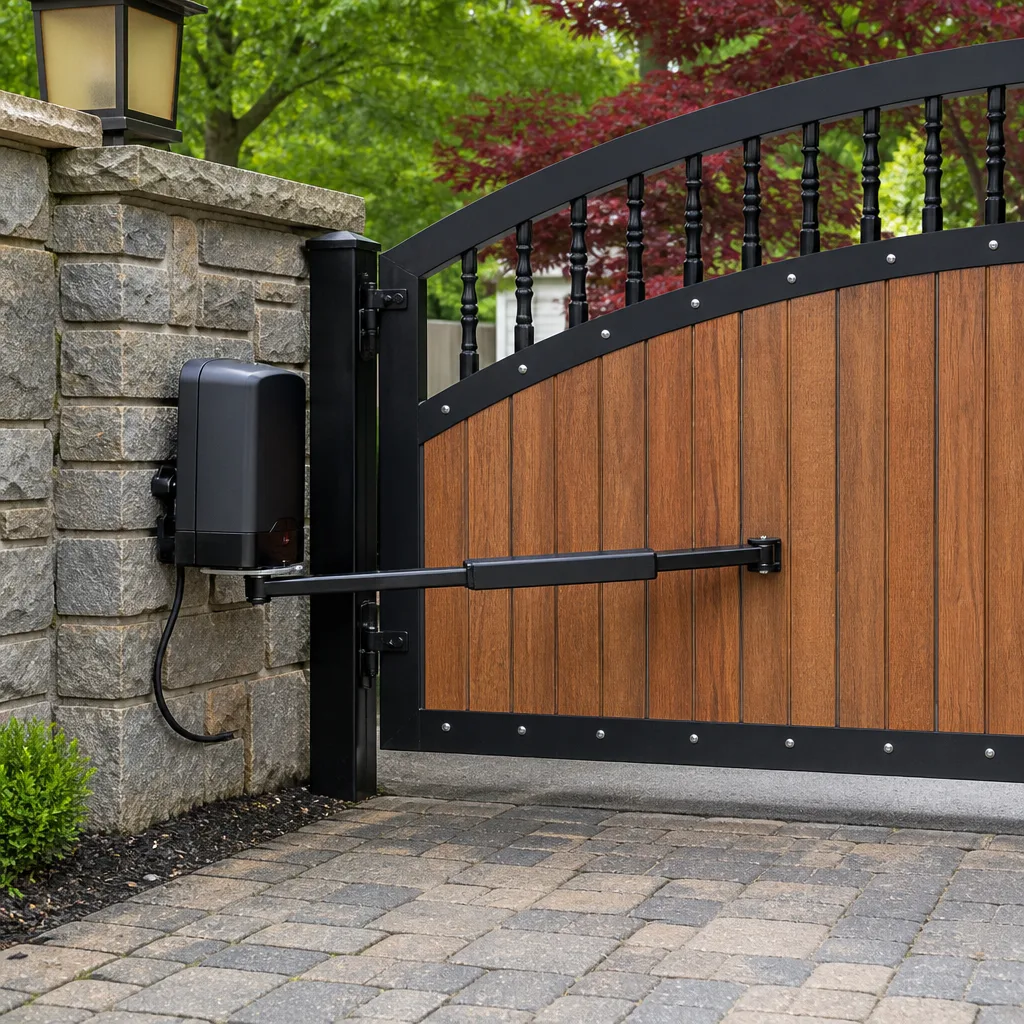 LiftMaster operators
Free on-site gate assessment - hinges, posts, and your LiftMaster or Nice gate operator checked before anything is quoted
The assessment is free and the quote is the invoice.
Get your free estimateGate Repair Maintenance Checklist for San Clemente Homeowners
If you’re searching for a gate maintenance checklist for your San Clemente home, you’ve probably already discovered that most of what’s online is written for houses in Arizona or Ohio. The problem is that those guides are actively harmful here. Our specific salt-air conditions, the near-constant marine layer by the coast, and the intense UV exposure you get in the hills above El Camino Real all change what your gate needs. One wrong lubricant within a mile of the Pacific can turn a perfectly good hinge into a rusted failure point in under a season. This guide is built for 92672 and 92673, covering exactly what to check, what to use, how often to do it, and which tasks mean it’s time to call a San Clemente gate specialist before a small issue becomes an operator replacement.
In the sections below, we walk through the real maintenance intervals for coastal Orange County gates, the specific products that work in salt air, the three checkpoints that prevent the most expensive repairs we see, and the safety tests every homeowner should run themselves. For Gate Repair Troubleshooting: Common Problems and How to Fix Them, see our dedicated guide.
Quick Answer
A San Clemente homeowner with an electric gate should perform a 10-minute visual and manual inspection every 30 days, apply marine-grade lubricant to hinges and rollers quarterly (or monthly if you’re within a mile of the coast), test the safety reversing mechanism monthly, and schedule a professional inspection of the operator, chain or belt tension, and limit switches annually. If your gate squeals, shudders, reverses incorrectly, or the operator hums without moving the gate, stop using it and call a specialist before a small part fails into a full motor replacement.
Styles & brands we work with
- Wrought iron
- Wood & steel frame
- Farm & ranch
- Sliding driveway gates
- LiftMaster operators
Table of Contents
- Coastal Lubrication: What Actually Works in San Clemente Salt Air
- The Monthly Checklist (10 Minutes, No Tools Needed)
- The Quarterly Checklist (30 Minutes, Basic Tools)
- The Annual Checklist (Full System Inspection)
- The Three Checkpoints That Prevent the Most Expensive Repairs
- How to Test Your Gate’s Safety Reversing Mechanism Yourself
- When Maintenance Turns Into Repair: Warning Signs
- Common Mistakes to Avoid
Coastal Lubrication: What Actually Works in San Clemente Salt Air
Using WD-40 on a gate hinge within a mile of the San Clemente coastline doesn’t lubricate it. It strips whatever protective film was on the metal and accelerates rust by trapping moisture in the joint. We replace hinges every month in Dana Point, Capistrano Beach, and San Clemente’s beachside communities that failed purely because someone used a general-purpose spray from the garage shelf. WD-40 is a solvent first, a water displacer second, and a lubricant a distant third. On a gate hinge exposed to marine air, it’s worse than doing nothing.
What actually works in this climate is a marine-grade lithium grease or a heavy stainless-rated synthetic grease. Look for products labeled for saltwater or marine use. Avoid anything thin, anything that sprays clear and evaporates, and anything with “penetrating” in the name. Penetrating oils are for loosening seized fasteners, not for lubricating a hinge that swings 300 times a month.
Where to apply coastal-grade lubricant:
- Hinge pins and leaves: The pivot points where the gate leaf attaches to the post. This is the highest-failure area we see on swing gates in San Clemente. Apply grease to the pin, the top of the leaf, and the weld points where stress concentrates.
- Roller wheels on slide gates: The bearings inside the rollers degrade fast in salt air. Grease the roller axles, not the wheel surface, which needs clean contact with the track.
- Chain and sprocket teeth: Light coat on the chain links and the teeth where the chain engages the drive sprocket. Avoid over-greasing; excess grease captures salt dust and becomes an abrasive paste.
- Track surfaces on slide gates: Keep tracks clean and dry. Do not grease the track surface itself. Salt-caked grease on a track is a leading cause of roller binding and motor strain on slide gates.
How often to lubricate by San Clemente zone:
- Within 1 mile of the coast (Pier Bowl, Southwest San Clemente, Capistrano Shores, T-Street, North Beach): Monthly. Salt fog is airborne and constant. In spring and early summer, when the marine layer sits heavy, we see the worst of it.
- 1 to 3 miles from the coast (Marblehead, Talega, Forster Ranch, Rancho San Clemente): Quarterly. You still get salt in the air, but UV actually helps here by burning off morning condensation faster.
- Inland of 3 miles (Ortega foothills, eastern Talega): Quarterly is still the right interval. Inland heat and dry dust cause their own wear on bearings and operator components.
The Monthly Checklist (10 Minutes, No Tools Needed)
This is the walk-around inspection we recommend every San Clemente homeowner do on the first weekend of the month. It takes ten minutes, requires no tools, and catches most mechanical failures before they reach the operator motor. Set a recurring phone reminder; gates fail silently, and the homeowner who catches a loose hinge in month one saves the operator replacement that comes in month eight.
Time estimate: 10 minutes.
- Watch the gate open and close fully once. Stand where you can see the full sweep. The gate should move at a constant speed with no hesitation, no shuddering, no pause-and-surge. A gate that slows down halfway through its cycle is a gate telling you something is wrong.
- Listen during the cycle. A healthy San Clemente gate is nearly silent. A squealing hinge means metal-on-metal contact and no lubrication left. A grinding sound from the operator box means a gear or bearing is wearing. A ratcheting sound on a slide gate usually means a chain has lost tension.
- Check the gap at the hinge side. On a swing gate, the gap between the gate leaf and the hinge post should look even top to bottom. If the gate sags and the gap opens wider at the top, the hinge or the hinge weld is failing. In coastal San Clemente, this usually starts with the lower hinge corroding faster than the top one.
- Inspect the track or wheel path. For slide gates, look at the track. Pebbles, sand, or plant debris are the biggest enemies of a slide gate in San Clemente. Sand from beach gear and coastal winds grinds down rollers and tracks. Clear anything you see.
- Look at the operator box. Check for visible rust, peeling paint, or corrosion around the seams. Salt air attacks the cabinet long before it attacks the internals, but a breached cabinet means the internals are next.
- Test the photo eyes or safety edges. Wave your hand in front of the safety beam or press the safety edge while the gate is closing. The gate should reverse immediately. If it doesn’t, this is not a maintenance issue. This is a safety failure that needs same-week attention.
The Quarterly Checklist (30 Minutes, Basic Tools)
Every three months, add a hardware-level inspection to the monthly visual. This is where you apply lubricant, check fasteners, and verify electrical connections. For coastal San Clemente properties, the quarterly schedule should follow the season: do this in January, April, July, and October. The post-rain spring check and the post-summer UV check are the two most important of the year.
Time estimate: 30 minutes.
- Apply marine-grade grease to all hinge points, roller axles, and chain or belt drive components. Use the product and locations covered in the coastal lubrication section above. A thin, even coat beats a heavy glob.
- Check every visible bolt, nut, and lag screw. Gates move thousands of cycles per quarter. Hardware shakes loose. Use a wrench or socket, not just your eyes. The two most common we find loose on San Clemente gates are the operator mounting bolts and the hinge post lag screws.
- Inspect the battery in a battery-backup operator. Many San Clemente homeowners have backup batteries because our grid is far less reliable than the rest of Orange County, especially in the canyon and hill communities. Check the battery terminals for corrosion, the casing for swelling, and the charge indicator on the operator board.
- Clean the photo eye lenses. A surprising number of gate failures in San Clemente are caused by dirty photo eyes. Salt film, dust, and spider webs accumulate on the lenses. Wipe with a dry cloth, then a slightly damp one. Do not use glass cleaner with ammonia on plastic lenses; it clouds them permanently over time.
- Verify the manual release. Open the manual release on your swing or slide gate operator and move the gate by hand through a partial cycle. It should move with steady resistance, not feel heavy, and not drag or grind. This also confirms the release mechanism is not seized, which is common near the coast.
- Inspect the keypad, intercom, and remote controls. Replace remote batteries before they fail. Check that the keypad buttons respond crisply. On coastal properties, keypad buttons and faceplates corrode fast; a stiff button now is a dead keypad in three months.
The Annual Checklist (Full System Inspection)
Once a year, your gate needs a deeper look than a homeowner walk-around can provide. We see this as a two-part job: what you can do yourself, and what requires a San Clemente gate specialist with a meter, a torque gauge, and experience with your specific operator brand.
Homeowner portion (30-45 minutes):
- Full clean of the gate and track. Use a hose and a soft brush. Remove salt buildup, bird droppings, and embedded sand. For an iron gate in coastal San Clemente, check every surface for rust spots and wire-brush or sand any spot you find before it spreads under the paint.
- Paint or seal bare metal. Bare metal exposed to San Clemente salt air will rust within weeks. Use a cold galvanizing spray or a rust-converting primer, then topcoat for UV protection. This is genuinely one of the highest-value maintenance items a homeowner can do.
- Check the gate’s balance. With the operator in manual release, swing or slide the gate to the midpoint of its travel and let go. The gate should hold position. If it swings open or closed on its own, the gate is out of level or the hinges are worn, and the operator motor is working against gravity on every single cycle.
- Document everything. Note any rust, any change in sound, any slowdown in the cycle. This record is what makes the professional visit fast and accurate.
Professional portion:
- Chain and belt tension check. A chain that has stretched will slip on the sprocket and wear both parts prematurely. A belt that has lost tension will cause the operator to fault intermittently. Both are fast adjustments with the right tools and experience, and both are easy to overtighten if you guess.
- Limit switch verification. Limit switches tell the operator where the open and closed positions are. In San Clemente’s coastal climate, switches drift with temperature swings, salt corrosion, and the minor settling that every hillside property experiences. A limit switch that has drifted an inch means the gate never fully closes, or slams into the stop every time it opens.
- Control board inspection. Look for swollen capacitors, heat discoloration, corroded terminals, and dead battery indicators. Control boards live in a metal box in the sun and the salt air; they fail from heat plus moisture, not from age alone.
- Safety system testing under load. Photo eyes, safety edges, and loop detectors should be tested with a calibrated force gauge where required. This is not a homeowner-appropriate test; it requires calibration tools and familiarity with UL 325 requirements for gate operators.
The Three Checkpoints That Prevent the Most Expensive Repairs
In our experience, three specific failure points account for the majority of expensive gate repair calls in San Clemente. All three are visible and audible months before they fail, which makes them preventable with the routine above. These are the three things we look for first on every gate we inspect.
1. Hinge Wear
Hinges are the single highest-failure component on swing gates in San Clemente, and the failure is almost always visible. A gate that sags, scrapes the ground at the latch end, or has a widening gap at the top hinge is telling you the hinge pin or the hinge leaf is worn. In coastal zones, the bottom hinge fails first because it sits in the wettest, saltiest air. Catch it at the sag stage and the fix is a hinge replacement. Ignore it and the gate’s weight transfers to the operator shaft, which then destroys the operator gearbox. A $150 hinge becomes a $1,800 operator replacement. The monthly sag check is the single best money-saving habit a San Clemente homeowner can build.
2. Chain or Belt Tension
Chain and belt drive systems need predictable tension. Too loose and the drive skips, jerking the gate and shocking the operator. Too tight and every cycle puts excess radial load on the motor bearings and drive sprocket. Coastal San Clemente creates a specific failure mode here: salt corrosion in the chain links causes uneven stiffening, which mimics the symptoms of low tension. The gate may run fine, then jerk when the stiff links pass through the sprocket. A proper tension check with a corrosion inspection of the chain itself catches this. We also see more belt drives in modern San Clemente installations, especially on LiftMaster and Elite residential operators, and belts have their own specific stretch and age-crack indicators.
3. Limit Switch Drift
Limit switches are simple mechanical or magnetic components, but they dictate the entire performance envelope of the operator. When a limit switch drifts, the operator runs the motor too long or stops it too early. Too long and the gate crashes into its end stop or the motor stalls, which overdraws current and cooks the control board. Too short and the gate never fully closes, leaving a gap that defeats the entire point of having a gate. San Clemente’s temperature swings between the cool marine zone and the hot inland canyons accelerate limit drift. If your gate has started stopping a few inches short, or slamming into its stop, that is a limit switch adjustment, not a motor replacement. Catch it the month it starts.
How to Test Your Gate’s Safety Reversing Mechanism Yourself
Every electric gate in San Clemente is required to have a safety system that reverses the gate if it encounters an obstruction while closing. UL 325 sets the standards for this, and while the full compliance testing requires specialized equipment, a homeowner can run a functional check monthly without any tools or training. Here is what a correct safety response looks like and what a failure looks like.
The functional test:
- Stand clear of the gate’s path. Trigger the gate to close using your remote or keypad.
- While the gate is closing, pass your hand through the photo eye beam. If your gate uses photo eyes, the gate should reverse immediately and return to the open position. This verifies the photo eye circuit is working.
- If your gate has a physical safety edge or contact strip on the leading edge, test it separately. Place a soft object like a rolled towel in the gate’s closing path. The gate should touch the object and reverse immediately, without applying full force.
- Watch how fast the reversal happens. The gate should not slow to a stop and then reverse; it should reverse as the dominant action. Any delay, any hesitation, or any failure to reverse is a failed test.
What a failure actually looks like:
- The gate continues closing after the beam is broken.
- The gate slows but does not reverse.
- The gate reverses only after significant force has been applied to the obstruction.
- The safety edge is cracked, separated from the gate, or shows visible corrosion at the mounting points.
- The operator faults and stops but does not reverse.
If any failure occurs, stop using the gate in automatic mode. Operate it manually or leave it in the open position until a gate specialist can diagnose and repair the safety circuit. A gate that runs without a functioning safety system is a serious liability and a direct code violation in San Clemente. For details on local requirements, see Gate Repair Permits, Codes & Inspections in CA: What You Need to Know. Do not attempt to bypass or disable a safety device to keep the gate working. That decision turns a maintenance issue into an injury risk.
When Maintenance Turns Into Repair: Warning Signs
The line between maintenance and repair is crossed when a component no longer responds to adjustment or lubrication. Here are the signs that a San Clemente homeowner should stop treating the issue as a checklist item and start treating it as a repair call.
Warning signs that mean repair, not maintenance:
- The gate hums but does not move. This means the operator motor is getting power and trying to run, but the drive system is locked or the capacitor has failed. Continuing to cycle it will burn the motor or the control board.
- The gate moves a few inches and stops. This is often a limit switch fault or an obstruction sensor that has failed open. It will not resolve with lubrication.
- Visible cracking or bending at any hinge or weld point. Structural metal failure is not fixable with maintenance. Welding and hinge replacement are repair work.
- Water inside the operator cabinet. If you open the operator box and see moisture, condensation, or standing water, the cabinet seal has failed. The control board is already at risk. This is a repair to the cabinet and a full inspection of the internals.
- The operator trips its breaker repeatedly. This is an electrical fault, not a mechanical one. A motor drawing excess current or a shorted component needs diagnosis with a meter.
- The gate closes on an obstruction and does not reverse. Covered in the safety test section above. This is a safety system failure and requires same-day professional attention.
When any of these appear, it is time to call a San Clemente gate specialist for professional Gate Repair services. The cost of diagnosing and repairing a limit switch or a failed capacitor is a fraction of the cost of the full operator replacement that follows if the gate keeps running in a degraded state. We see this cycle play out every month: a homeowner notices a warning sign, keeps using the gate for another season because it still opens and closes, and then pays for the full failure that was inevitable from the moment the warning sign appeared.
Common Mistakes to Avoid
- Using WD-40 or a general-purpose penetrating spray as a lubricant. In San Clemente’s salt air, this strips protective coatings and accelerates hinge rust. Use marine-grade lithium or synthetic grease instead.
- Greasing the slide gate track. Grease on a track surface captures sand and salt and turns into an abrasive sludge that destroys the rollers. Track surfaces stay clean and dry; only the roller axles get grease.
- Ignoring a sagging gate because it still opens. A gate that sags an inch at the latch is already transferring destructive load to the operator. The hinge fix is cheap; the operator replacement is not.
- Assuming a humming operator is a dead motor. Often it is a failed start capacitor or a seized drive component, both of which are less expensive than a motor replacement. Never keep cycling a humming gate; you will turn the cheap failure into the expensive one.
- Skipping the monthly safety reversal test. This is the single most important safety habit for any San Clemente homeowner with an electric gate. A gate that converts to a non-reversing steel barrier is a legal and physical danger.
- Using glass cleaner on photo eye lenses. Ammonia-based glass cleaners cloud plastic lenses permanently over time. Dry cloth or plain water only.
- Painting over existing rust without wire-brushing or treating it first. Rust continues spreading under fresh paint. Remove the rust, treat the metal, then paint. Otherwise you are just hiding the problem from yourself.
See the difference
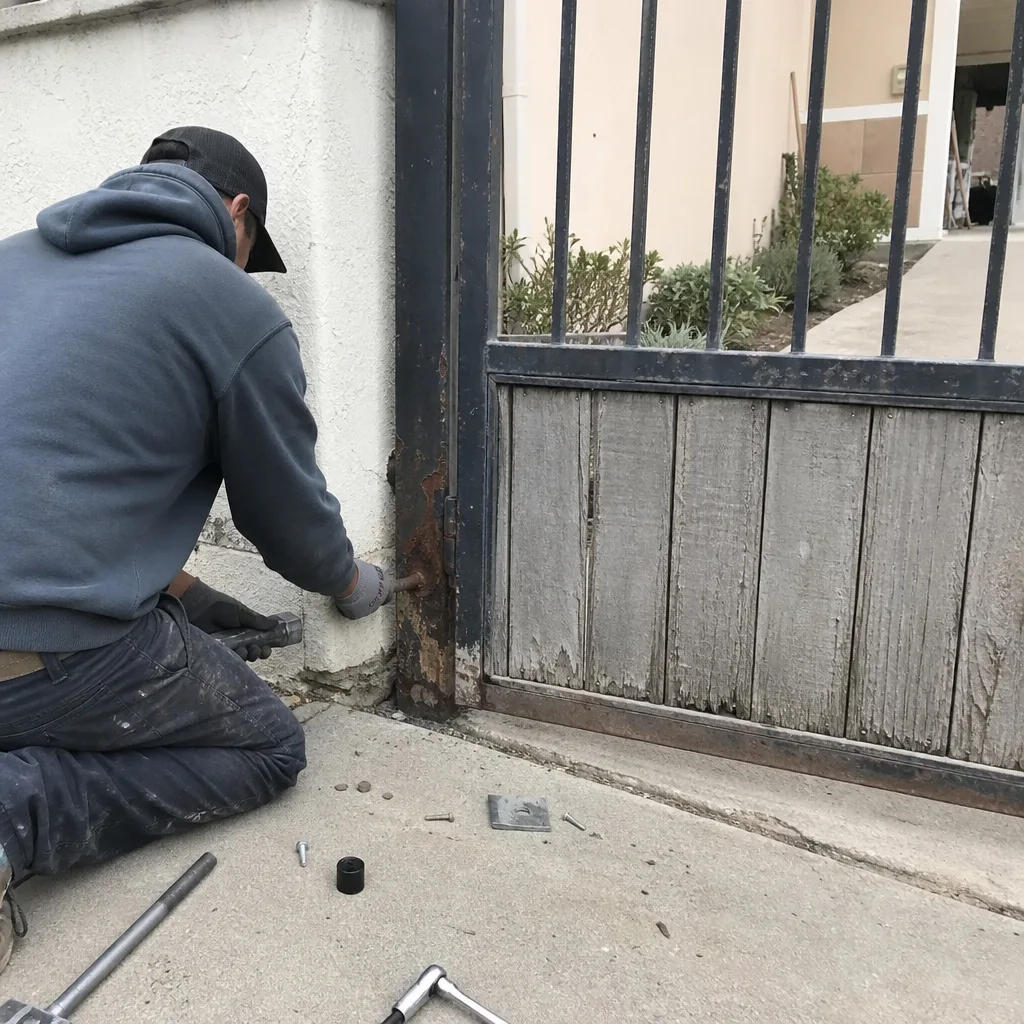 Before
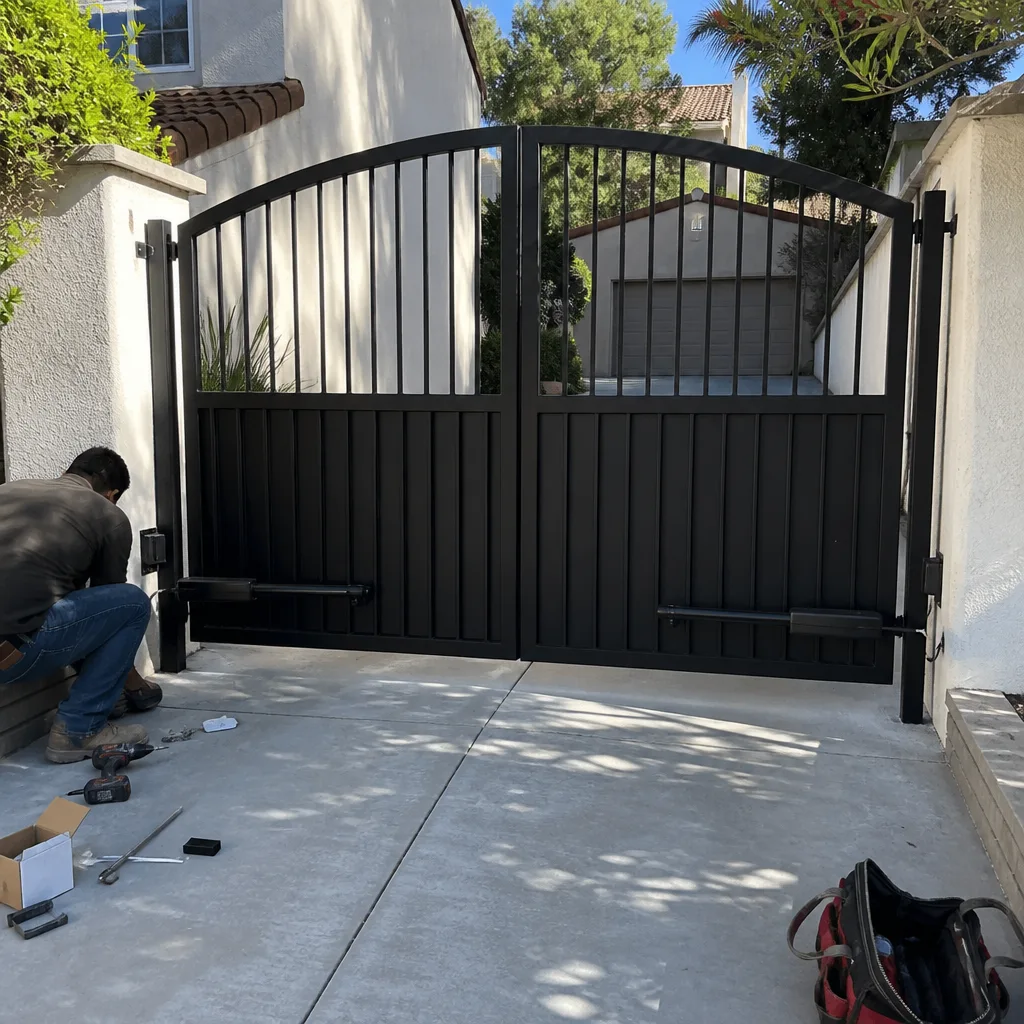 After
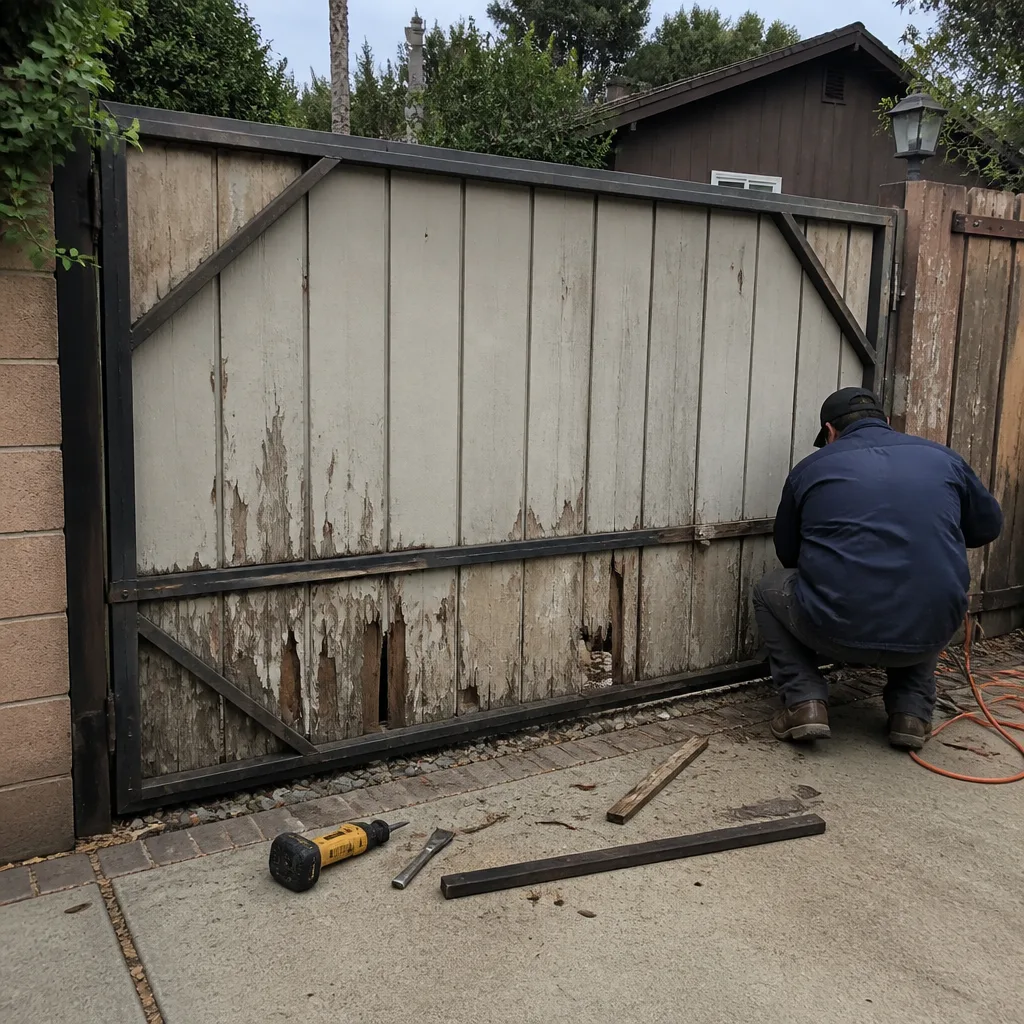 Before
 After
 Before
 After
When to Call a Professional
If your quarterly or annual inspection turns up any of the warning signs above, or if you are not comfortable performing the safety reversal test correctly, call a specialist before the gate runs another month. The situations that most clearly warrant a professional are: a gate that fails to reverse on obstruction, a humming operator, repeated breaker trips, visible structural cracking at any weld or hinge, any sign of water intrusion in the operator cabinet, or a slide gate that has come off its track entirely. These are not maintenance items. A gate specialist will diagnose the exact failure, quote the repair before any work starts, and typically have the part needed on the same visit. Gate Repair San Clemente offers free estimates in San Clemente; call (866) 282-7403 and we will tell you honestly whether your gate needs a maintenance adjustment or a real repair.
For homeowners who prefer to keep a scheduled professional on the calendar, an annual inspection from a gate specialist who knows Gate Repair San Clemente home service standards costs less than the motor or control board that it prevents. We work on LiftMaster, Elite, Mighty Mule, DoorKing, and the full roster of brands commonly installed in San Clemente residential and commercial properties. We are Gate Repair in San Clemente specialists, not generalists; the diagnosis is faster and the parts are brand-accurate because this is all we do. If your gate uses an electric operator, you can read more about our specific approach at Electric Gate Repair in San Clemente. If your current gate has reached the point where maintenance is no longer saving you money, our Gate Installation in San Clemente service covers full replacement with brand-accurate installation.
Frequently Asked Questions
If you live within a mile of the coast, lubricate gate hinges and roller axles every month with a marine-grade grease. If you live further inland, every three months is usually sufficient. The salt air in San Clemente’s beach communities like Pier Bowl, North Beach, and Capistrano Shores accelerates corrosion far faster than the dry inland air of Talega or Forster Ranch. A monthly walk-around inspection is still the right interval for every San Clemente homeowner, even if lubrication happens less often. Call (866) 282-7403 if you are unsure which lubricant is correct for your specific gate and location; estimates are free.
No. WD-40 is a solvent and water displacer, not a lubricant. In San Clemente’s marine air, it strips the protective film from the hinge and traps moisture, which accelerates rust. Use a marine-grade lithium grease or heavy synthetic grease designed for saltwater environments. If you already used WD-40, clean the hinge thoroughly and re-grease it correctly at the next monthly interval.
Homeowner maintenance with marine-grade grease, a wire brush, and basic hand tools costs under $50 per year in materials. A professional annual inspection and tune-up in San Clemente typically runs between $150 and $350 depending on the gate type, the operator brand, and how much adjustment is needed. The repair that a regular inspection prevents, usually an operator replacement from hinge neglect or limit switch failure, costs $1,200 to $2,500 or more. The maintenance is the cheap path. Call (866) 282-7403 for an exact quote on an inspection; estimates are free.
Yes. If your gate is stuck closed, stuck open, or failing to reverse on obstruction, call (866) 282-7403. We prioritize safety failures and access-blocked situations in San Clemente and will get a technician out as fast as the schedule allows. If the gate still opens manually and the failure is intermittent, same-week service is usually fast enough to prevent any further damage.
A full annual inspection from a San Clemente gate specialist includes chain or belt tension adjustment, limit switch verification and adjustment, control board inspection for corrosion and heat damage, safety system testing, hinge and weld inspection, operator cabinet seal inspection, and a full lubrication service with marine-grade products. You receive a written summary of what was found, what was adjusted, and what will need attention at the next interval. Call (866) 282-7403 to schedule; estimates are free.
Yes. We service LiftMaster, Elite, Mighty Mule, DoorKing, and the rest of the major residential and commercial operator brands installed in San Clemente. Our technicians carry brand-specific parts and service bulletins for each system, so the diagnosis is accurate and the repair does not require a second visit for parts. If your existing operator has failed beyond economical repair, we can also handle the full Gate Installation in San Clemente replacement without referring you to a separate contractor.
The Bottom Line
Your San Clemente gate lives in one of the harshest environments for metal and electronics in Orange County. Salt air, heavy marine-layer condensation, intense coastal UV, and hillside settling all work together to create failures that a generic maintenance checklist never anticipates. The fix is simple: inspect monthly, lubricate quarterly with marine-grade grease, test the safety reversal every month, and schedule one professional annual inspection that covers chain tension, limit switches, and the control board. The three checkpoints that matter most, hinge wear, drive tension, and limit switch drift, are all visible if you look. Catch them early and the repair costs a couple hundred dollars. Miss them and you are replacing an operator. If anything in this guide feels uncertain or your gate is already showing warning signs, call (866) 282-7403 for a free estimate from a San Clemente gate specialist who knows your brand.
Written by the team at Gate Repair San Clemente, serving San Clemente since 2012. Explore our more guides & resources for gate maintenance and repair.